SHARE WITH A FRIEND

Malta’s commercial property market is often assessed through a narrow lens of rental pricing, location scarcity, and sector demand. While these elements are important, they do not fully explain why sustained corporate interest continues to concentrate in specific business districts.
A more structural driver sits beneath the surface. Government incentives designed to attract and retain international companies are actively shaping where businesses choose to establish operations, how much space they require, and how long they remain in the market.
Rather than directly subsidising commercial rent, Malta’s economic framework reduces the overall cost of doing business through tax efficiency, investment support, and employment incentives. These mechanisms create a consistent inflow of corporate entities requiring physical office presence. The result is a property market influenced not only by supply and demand fundamentals, but by policy-engineered corporate migration.
This dynamic is particularly relevant for investors, landlords, and occupiers evaluating office space Malta-wide. Understanding how incentives translate into real estate demand provides a clearer view of rental stability, district performance, and long-term occupancy trends.Malta’s Corporate Incentive Framework Explained
Malta’s incentive ecosystem is primarily administered through Malta Enterprise, which operates as the central agency supporting foreign direct investment, business expansion, and innovation-driven industries.
These incentives are not structured as blanket financial subsidies. Instead, they are targeted mechanisms aimed at attracting companies that contribute to employment growth, exports, and sectoral diversification.
Key components of the incentive framework include investment aid tax credits, cash grants for expansion, innovation and research funding, and relocation support for high-value businesses. Companies may also benefit from wage-related incentives when hiring skilled employees, particularly in knowledge-based sectors.
The importance of this framework lies in its conditional nature. Incentives are typically tied to physical establishment in Malta. This requirement naturally drives demand for commercial premises, particularly office space and operational hubs.
From a real estate perspective, the incentive structure effectively acts as a demand generator for commercial property rather than a direct cost reducer for rent.
Corporate Tax Efficiency and Its Influence on Office Demand
One of the most significant drivers of corporate relocation to Malta is its tax efficiency model. While the standard corporate tax rate is 35%, the effective tax rate for many international shareholders can be significantly reduced through Malta’s refund system, often resulting in an effective rate between 5% and 10%.
This structure has positioned Malta as a competitive jurisdiction for holding companies, financial services firms, iGaming operators, and international service providers. However, the implications extend beyond taxation strategy.
When companies relocate to optimise their tax exposure, they also establish operational infrastructure. This includes office headquarters, administrative centres, compliance teams, and client-facing operations. As a result, tax policy directly influences demand for Grade A office space in Malta’s primary commercial districts.
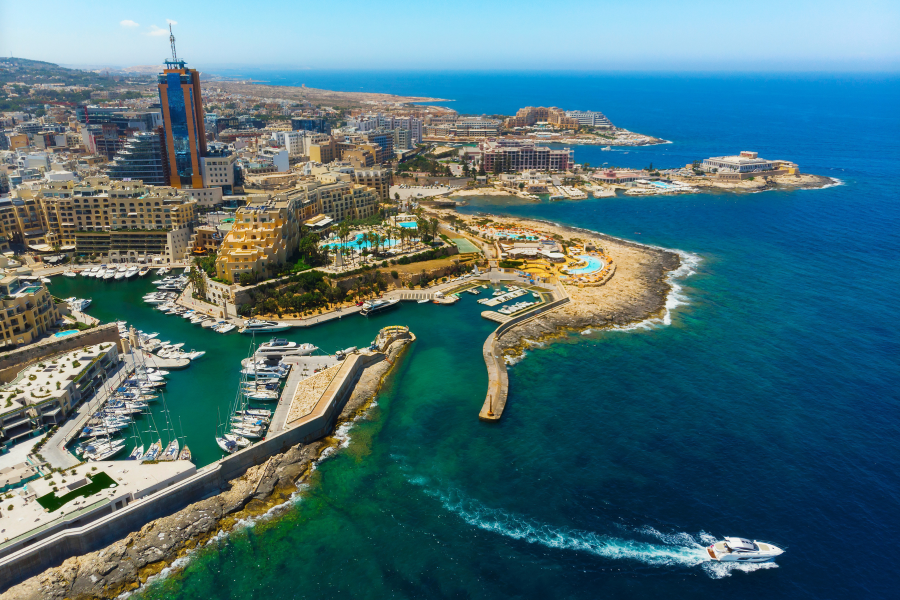
High demand is particularly visible in areas such as Sliema, St Julian’s, and the central business district of Mrieħel, where corporate tenants seek proximity to service providers, talent pools, and industry clusters.
Understanding Malta’s Tax Refund System and Its Role in Corporate Structuring
Malta’s tax refund system operates as a structured mechanism that determines how corporate tax paid at the company level is ultimately treated at the shareholder level. While widely referenced in discussions around Malta’s competitiveness, the system itself is technical, rules-based, and dependent on both the nature of corporate activity and the position of the shareholder.
At its core, the system follows a full imputation model, meaning that tax paid by a Maltese company is attributed to its shareholders when profits are distributed as dividends. Upon distribution, eligible shareholders may claim a refund of a portion of the tax paid. This process is not automatic at the company level and is only triggered once a dividend is declared and distributed.
How the refund mechanism operates in practice
A Maltese company is taxed at the standard rate of 35% on its profits. Once those profits are distributed as dividends, shareholders may apply for a refund of a portion of the tax paid, depending on the nature of the income and the structure of the company.
The most commonly applied refund structures include:
- 6/7 refund - This applies to trading income and is the most widely used structure for operational companies. It results in an effective tax rate of approximately 5%.
- 5/7 refund - This applies to passive income such as interest and royalties. The effective tax rate is typically higher than trading income due to the passive nature of earnings.
- 2/3 refund - This applies where double taxation relief has already been claimed at the company level. It ensures that tax benefits are not duplicated.
- Full refund in specific cases - In limited circumstances, such as participation exemptions on qualifying holdings, no tax may ultimately be payable at the shareholder level.
The refund is paid by the Maltese tax authorities directly to the shareholder after a valid claim is submitted, typically within a defined administrative timeframe once all compliance requirements have been met.
Key criteria and conditions for eligibility
The effectiveness of the refund system depends on compliance with Malta’s regulatory and tax framework. It is not a blanket reduction and requires proper structuring and operational substance.
- Shareholder eligibility - Refunds are generally available to non-resident shareholders or entities structured in a way that aligns with Malta’s tax legislation. The shareholder must be properly registered and recognised within the Maltese system.
- Distribution of profits - The refund is only triggered when profits are distributed as dividends. Retained earnings within the company do not qualify until distribution occurs.
- Nature of income - The type of income generated by the company determines the applicable refund rate. Trading income benefits from the most favourable treatment, while passive income is subject to different calculations.
- Tax compliance and documentation - Companies must maintain accurate financial records, audited accounts where required, and proper tax filings. Refund claims must be supported by documentation confirming tax paid and dividends distributed.
- Substance and economic activity - Increasingly, companies are expected to demonstrate real presence in Malta. This includes office space, employees, and operational activity. While the refund system itself is statutory, substantive requirements are critical in ensuring compliance with broader international tax standards.
Why the system incentivises physical presence
Although the refund system is often viewed purely as a tax benefit, its practical application encourages companies to establish genuine operations in Malta. Businesses seeking to utilise the structure typically require:
- A registered office and operational headquarters.
- Local directors or management presence.
- Administrative and compliance functions.
- Access to professional services such as legal, accounting, and regulatory support.
This creates a direct link between tax structuring and commercial property demand. Companies that benefit from the refund system are not merely holding entities. Many evolve into fully operational businesses with growing spatial requirements.
Implications for commercial real estate demand
The refund system contributes to Malta’s attractiveness as a jurisdiction for international business, but its real estate impact is often underestimated. By incentivising corporate establishment and profit distribution through Maltese entities, it drives:
- Demand for premium office space in central business districts.
- Long-term occupancy from internationally structured companies.
- Expansion of corporate footprints as operations scale.
- Increased competition for Grade A office environments.
In areas such as Sliema, St Julian’s, and Mrieħel, this has translated into consistent demand from companies that are structurally tied to Malta through their tax and corporate frameworks. The result is a commercial property market supported not only by economic activity but also by a regulatory system that encourages companies to maintain a physical and operational presence within the jurisdiction.
How Investment Incentives Translate into Physical Property Demand
The refund system plays a defining role in attracting internationally structured companies to Malta, but its impact on commercial real estate extends beyond initial relocation. Businesses operating within this framework are typically long-term in nature, with established governance, compliance requirements, and ongoing operational needs. This results in a distinct demand profile within the commercial property market, characterised by:
- Long-term occupancy from internationally structured tenants.
- Preference for high-quality office environments aligned with corporate standards.
- Stable leasing patterns driven by regulatory and operational continuity.
- Concentration in established business districts with access to professional services.
This creates a tenant profile that is structurally aligned with long-term occupancy, reinforcing stability across Malta’s prime office assets.
Employment Incentives and Corporate Growth Strategy
Malta’s corporate incentive framework places measurable emphasis on employment creation, with several schemes directly linking financial support to workforce expansion. These schemes are structured programmes designed to reduce labour costs, incentivise job creation, and encourage long-term operational growth within the jurisdiction. The most relevant employment-linked incentives include wage-based tax credits, cash grants tied to payroll expansion, and training support for workforce development.
Key employment-linked incentives available to companies
A number of schemes administered through Malta Enterprise and related frameworks directly incorporate employment as a qualifying factor.
- Investment Aid Tax Credits - Companies undertaking qualifying investment projects may receive tax credits calculated as a percentage of either capital expenditure or wage costs associated with new jobs. These credits can be applied over multiple years, improving long-term cash flow.
- Business Development Scheme - This scheme supports expansion, restructuring, and scaling initiatives, with eligible costs including wages, advisory services, and operational expenditure. Support can reach up to 75% of eligible costs, capped at €300,000 over a three-year period.
- MicroInvest Scheme - Targeted at smaller enterprises, this incentive provides tax credits on investments, including increased wage costs, provided the company meets size thresholds such as fewer than 50 employees and turnover below €10 million.
- Skills Development and Training Support - Companies may receive funding to train employees, upskill teams, and improve workforce capability through tax credits or cash grants, particularly in specialised or high-value sectors.
What benefits do companies actually receive?
From a corporate perspective, these incentives materially reduce the cost of building and scaling a workforce in Malta.
The most relevant advantages include:
- Reduction in effective labour costs through tax credits linked to wages.
- Cash-flow support through grants during early-stage expansion or scaling phases.
- Risk mitigation when hiring at scale, particularly in new markets.
- Support for specialised talent acquisition, especially in technical or regulated industries.
Importantly, many of these benefits are structured over time rather than as one-off payments. This encourages companies to maintain employment levels and continue expanding operations within Malta.
- Qualifying criteria and compliance requirements - Access to these incentives is conditional and requires companies to meet clearly defined criteria. These requirements are critical, as they directly influence how businesses structure their operations and, by extension, their real estate needs.
- Establishment of an operating base in Malta: Companies must have a physical presence, including leased or owned premises and active operations within the country.
- Minimum employment requirements - At least one full-time employee is generally required, with many schemes incentivising additional job creation linked to investment projects.
- Job creation tied to investment timelines - New roles must typically be created within a defined period, often within three years of completing an investment project, and maintained for a minimum duration.
- Eligible sectors and activities - Incentives are generally targeted toward sectors such as ICT, financial services, manufacturing, aviation, and other high-value industries aligned with Malta’s economic strategy.
- Pre-approval and application process - Companies are often required to obtain approval before commencing projects to ensure eligibility for funding and tax benefits.
How Employment Growth Translates into Office Space Demand
Once these incentives are activated, workforce expansion becomes a central component of corporate strategy. As teams expand, office environments are redefined, and layouts shift toward collaborative and departmental structures, additional functions are introduced, and space allocation becomes more deliberate. In many cases, this leads to internal expansion within the same building or relocation into larger, more structured premises that better reflect the company’s operational maturity.
Sector Clustering and the Creation of High-Demand Business Districts
Malta’s commercial property market has a clear concentration of corporate activity within specific geographic zones. This creates distinct commercial environments with specialised tenant profiles. Each zone develops its own functional identity, shaped by the industries that dominate within it and the supporting ecosystem that forms around them.
- Sliema and St Julian’s function as established centres for corporate headquarters and iGaming operators.
- Mrieħel accommodates a significant share of industrial, logistics, and back-office operations.
- Valletta attracts financial services and professional advisory firms.
In these areas, occupancy levels remain consistently strong, and competition for available office stock is more pronounced due to sustained tenant clustering.
Indirect Impact of Incentives on Commercial Rental Pricing
Malta’s commercial rental market does not rely on direct intervention or subsidy mechanisms to influence pricing. Instead, commercial rental values are determined by the behaviour of long-term corporate occupiers within established business districts. In prime office buildings, pricing tends to demonstrate greater resilience due to the stability of tenant profiles and the continuity of operational demand.
Lease structures in these environments often reflect this stability, with stronger emphasis on multi-year commitments, with rental adjustments more commonly observed at renewal stages rather than through frequent tenant movement. Secondary commercial properties pricing is more responsive to tenant churn and changing operational requirements, resulting in wider variation in achieved rental levels.
The overall effect is a segmented pricing environment, where stability is concentrated in Grade A assets supported by established corporate occupiers, while variability is more pronounced in non-core office stock.
What This Means for Commercial Property Demand in Malta
Government incentives are a structural driver of corporate establishment in Malta, directly influencing the need for physical office space across key business districts. This relationship between policy design and operational presence underpins consistent demand for commercial premises within the market.
For businesses entering or expanding in Malta, WorkSpaces provides access to a curated portfolio of commercial properties designed to support long-term operational requirements. To explore available opportunities or discuss tailored workspace solutions, contact WorkSpaces on +356 2010 8077, visit www.workspaces.mt, or visit the Portomaso Marina office or the Tigné Point Pjazza office to connect directly with a specialist team.